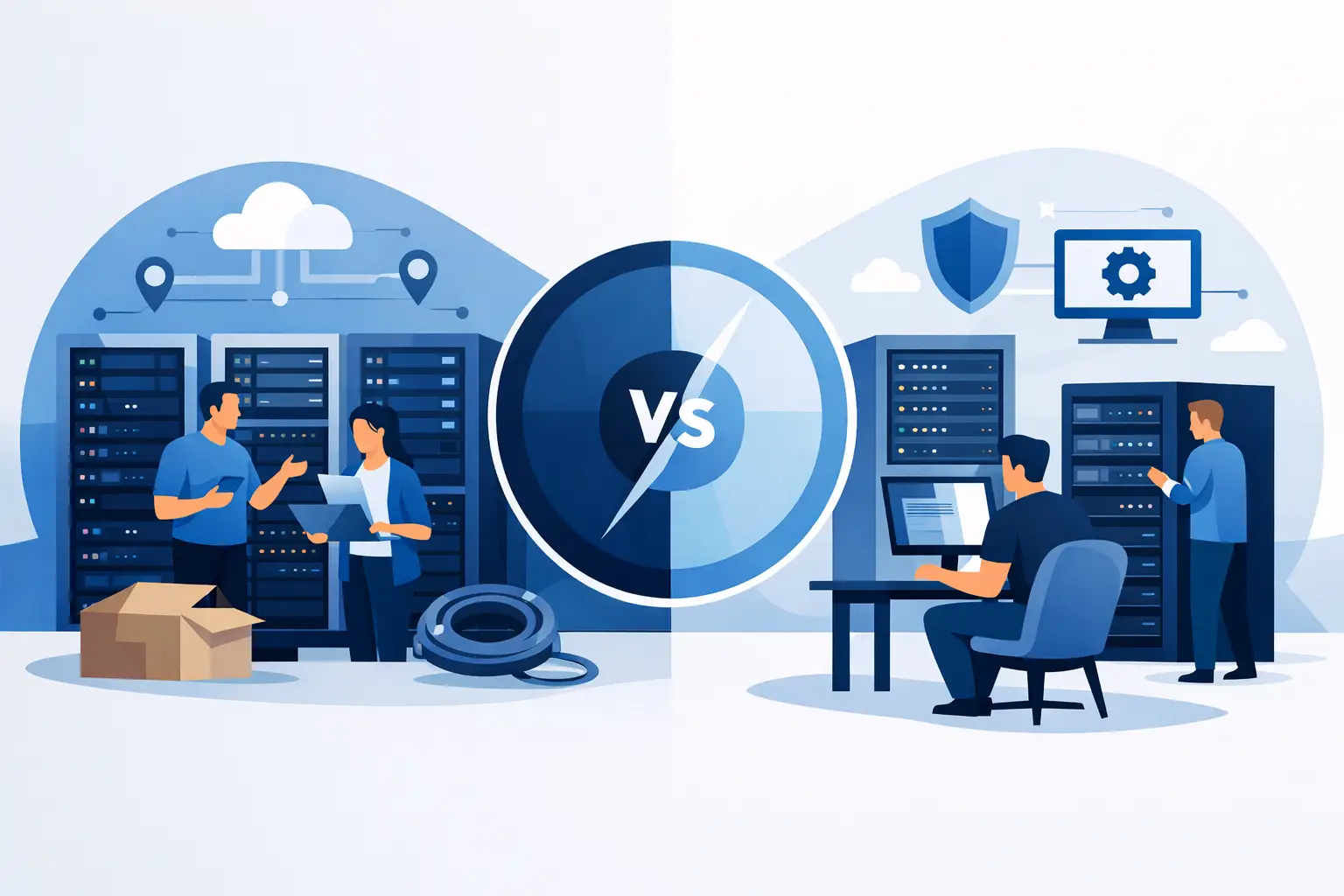
A lot of infrastructure decisions look simple until you price out the second year. That is especially true with colocation vs dedicated servers, where the right choice depends less on raw hardware and more on who should own the operational burden.
For some businesses, renting a dedicated server is the cleanest path to reliable capacity. For others, colocating owned hardware delivers better control, longer-term savings, or compliance alignment. The catch is that both options can be the right answer, and both can become expensive if they are matched to the wrong operating model.
Colocation vs dedicated servers at a glance
The practical difference is ownership and responsibility. With a dedicated server, you rent a physical server from a provider. The provider owns the hardware, handles replacement of failed components, and usually manages the facility-level pieces such as power, cooling, rack space, and network access. You get exclusive use of the machine, but you are not buying and maintaining the box itself.
With colocation, you bring your own server hardware into a provider's data center. You pay for space, power, bandwidth, and facility services, but the hardware remains yours. That gives you more control over component selection, lifecycle planning, and platform design, but it also means more responsibility when something needs to be upgraded, replaced, or physically serviced.
That difference sounds straightforward. In practice, it affects procurement, support workflows, security planning, spare parts strategy, and how quickly you can scale.
When dedicated servers make more sense
Dedicated servers are often the best fit when speed, simplicity, and predictable monthly costs matter more than hardware ownership. If you need a machine online quickly, renting usually wins. There is no procurement cycle for chassis, CPUs, RAID controllers, or memory compatibility. You choose a server profile, provision it, and start deploying workloads.
This model works well for web hosting, application servers, databases, agency environments, and private workloads that need isolated resources without the complexity of maintaining physical assets. It is also a strong choice for teams that are comfortable managing the operating system and applications but do not want to be responsible for failed drives at 2:00 a.m.
The support model is another advantage. If a power supply fails or memory goes bad, the provider replaces it. That reduces operational friction and lowers the need for on-site access or remote hands coordination. For many small and mid-sized businesses, that shift alone is worth more than the theoretical savings of owning hardware.
Dedicated servers also make capacity planning easier when your workloads change often. If your current server is undersized, you can migrate to a larger platform. If a project ends, you can reduce spend without being stuck with depreciating equipment. That flexibility matters for growing companies, agencies with variable client demand, and development teams that need room to adjust.
When colocation is the better choice
Colocation starts to look attractive when you already have hardware standards, internal infrastructure expertise, or specific technical requirements that rented platforms do not satisfy well. If your team wants complete control over server design, firmware policy, storage layout, network cards, or hardware security modules, owning the equipment may be the better path.
This is common in organizations running specialized databases, virtualization clusters, storage-heavy systems, licensed software tied to physical hardware, or environments where standard dedicated server configurations are too limiting. Colocation can also make financial sense when hardware will be used over a longer period and utilization is stable enough to justify the upfront investment.
There is also a governance angle. Some businesses want direct control over exactly what is installed in the rack, how systems are tagged, how BIOS settings are locked down, or how devices are segmented. A colocation setup can support those requirements cleanly, especially when paired with private network design and direct data center access.
The trade-off is operational ownership. If your server fails, the provider can supply remote hands, but they are not the owner of the hardware. Your team still needs a plan for replacement parts, warranty handling, maintenance windows, and lifecycle refreshes.
Cost is not just monthly price
Buyers often compare colocation vs dedicated servers by looking at the monthly invoice. That is useful, but it is incomplete.
Dedicated servers usually have lower upfront cost. You avoid capital expenditure, and hardware replacement is part of the service model. That can make budgeting easier, especially for businesses that prefer operating expense over buying assets. It also limits surprise spending tied to failed components or refresh cycles.
Colocation shifts the economics. You buy the hardware first, then pay recurring facility costs. Over time, that can work out well if the equipment is efficiently used and kept in service long enough. But the real cost includes sparing strategy, shipping, warranty terms, hands-on maintenance, and the internal labor required to manage physical infrastructure.
A cheaper monthly colocation footprint is not necessarily cheaper overall if your team has to spend significant time coordinating repairs or if growth forces an earlier-than-planned hardware refresh. On the other hand, a dedicated server rental can become less attractive over several years if you are running highly stable workloads on equipment you could have owned and amortized.
The honest answer is that the cost winner depends on time horizon and staffing model, not just rack fees versus rental fees.
Control, customization, and performance
If you care about exact hardware selection, colocation is hard to beat. You can choose the server platform, drive type, memory capacity, RAID layout, NICs, accelerators, and out-of-band management tools that match your workload. That level of control matters for performance-sensitive applications and custom infrastructure builds.
Dedicated servers still offer strong performance, and many providers now offer serious hardware options rather than basic commodity boxes. For most production websites, business applications, game servers, mail platforms, and database deployments, rented dedicated hardware provides more than enough consistency and headroom. The practical question is whether you need custom hardware, or whether you simply need dedicated resources.
That distinction matters. Dedicated resources solve a lot of performance problems without requiring you to own the machine. If your application benefits mainly from isolated CPU, RAM, and storage, a dedicated server may deliver the result you want with much less operational complexity.
Staffing changes the answer
The most overlooked factor in colocation vs dedicated servers is internal capability. If your team has infrastructure engineers who are comfortable managing hardware inventories, firmware updates, rack layouts, spare parts, and remote troubleshooting, colocation can be a strong fit. If not, the extra control may become a burden rather than a benefit.
Dedicated servers reduce the physical operations workload. Your team can focus on the operating system, security, applications, backups, and monitoring while the provider handles the hardware platform. That is often the better use of limited IT time, especially in smaller organizations where one person is already wearing too many hats.
This is why the technically stronger choice is not always colocation. Sometimes the stronger choice is the one that removes failure points from your internal process.
Security and compliance considerations
Both models can support serious security and compliance requirements if the facility and service design are sound. Colocation gives you tighter control over the hardware itself, which can be useful for organizations with strict chain-of-custody or device-level governance requirements. You decide exactly what enters the rack and when it gets replaced.
Dedicated servers can still satisfy demanding environments, particularly when hosted in certified facilities with controlled access, redundant infrastructure, and clear support procedures. For many businesses, the security baseline is driven more by system administration, patching, segmentation, credential management, and backup discipline than by who owns the chassis.
If your requirements are highly specific, ask a more precise question than "which is more secure?" Ask whether your controls depend on hardware ownership, or whether they depend on data center quality and operational discipline.
So which should you choose?
Choose dedicated servers when you want faster deployment, less hardware responsibility, easier support handling, and a predictable service model. They are often the best fit for growing businesses, developers, agencies, and IT teams that need dependable dedicated capacity without taking on physical infrastructure management.
Choose colocation when you need hardware-level control, have a clear long-term equipment plan, and can support the operational demands that come with owning the platform. It tends to fit mature environments with stable workloads, specific technical standards, or hybrid infrastructure strategies.
For some businesses, the right answer is not either-or. It is a mix. Core systems may live on colocated hardware, while edge workloads, temporary projects, or expansion capacity run on dedicated servers. Providers such as Internetport support both models for exactly that reason: infrastructure needs rarely stay static for long.
A good infrastructure decision should still look sensible after the first hardware failure, the first growth spike, and the first budget review. That is the test worth using.